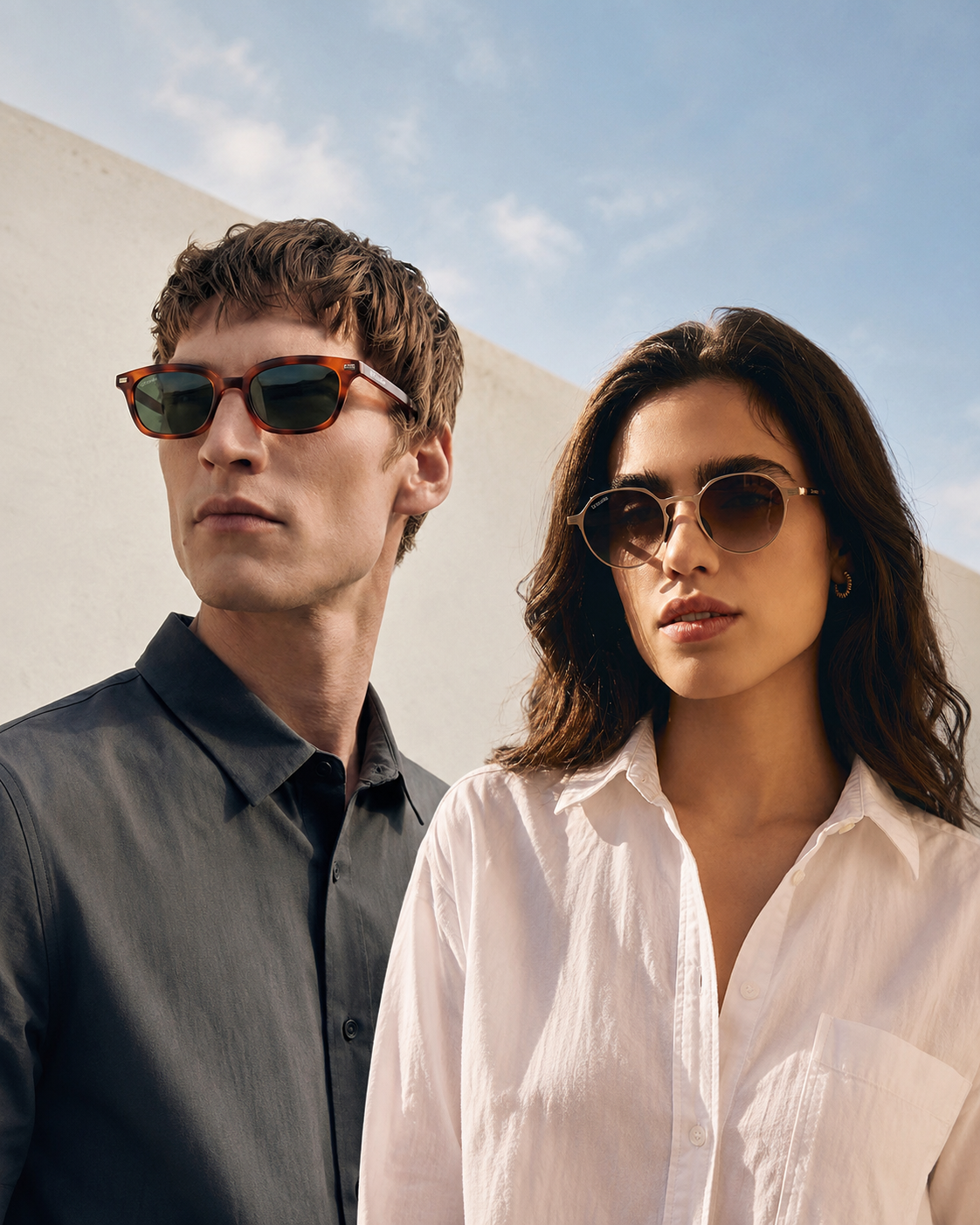
Sunglasses


Sunglass Frame Materials
The frame material determines weight, comfort, durability, resistance to sweat and impacts, and even how your sunglasses look over time. In lifestyle sunglasses such as those from D.Franklin, it also defines the character of each collection and how it fits into your daily life. Choosing the right material means you can wear your glasses comfortably for hours, prevent warping and get more from lens technologies such as OPTAREX™, photochromic lenses and polarisation. Choose poorly, and your glasses end up in a drawer or, worse, on the floor as soon as the temples lose their shape. Two main material families In practice, almost all frames on the market fall into two main families: metal and plastic. Each includes very different compositions and properties, from ultralight titanium to nylon blends designed for sports. Understanding these differences helps you decide which type best suits your actual needs, whether for everyday city wear or demanding athletic use. Metal frames: benefits and types Metal frames offer slimmer profiles, a clean look and a very precise fit. They are common in aviator sunglasses, geometric designs and minimalist urban styles. Technically, they stand out for their strength and their ability to support very slender bridges and temples without losing stability. Titanium Titanium is the benchmark when you want minimal weight and high strength. It resists deformation, stands up very well to daily use and is usually hypoallergenic, making it a good option if your skin reacts to other metals. It is useful for glasses worn for many hours at a time, such as frames for both everyday wear and work with a blue light filter. Aluminium Aluminium combines lightness and rigidity. It allows slim, stable frames and takes surface treatments and coloured finishes well, from understated matt shades to brighter tones. It is often used in contemporary designs where visible metal is desirable without excessive weight. Stainless steel Stainless steel is strong, resists corrosion from sweat and is easy to shape for a good temple fit. It is a very stable material, ideal if you do not want to worry about your glasses losing their shape over time. It weighs slightly more than titanium but remains comfortable in slim frame designs. Plastic frames: benefits and types Plastic frames dominate urban sunglasses for one simple reason: visual impact. They allow playful colours, bold volumes and chunky or retro designs that would be impractical in metal. From a technical perspective, the key is the type of polymer and how the frame is manufactured. In ranges such as D.Franklin’s sunglasses collections, most urban models use high-quality plastics precisely for this combination of lightness, colour and strength. Cellulose acetate Cellulose acetate is the classic choice for plastic frames. It adjusts well, withstands daily use and offers countless colours, patterns and translucent effects. It is ideal for retro-inspired frames, bold square sunglasses or striking cat-eye designs. When properly polished, it has a smooth feel and a distinctive shine. Cellulose propionate Propionate is an acetate derivative that is lighter and highly resistant to prolonged contact with skin, sweat and cosmetics. It is a good option if you tend to wear glasses all day and worry about wear around your nose and ears. Its weight-to-volume ratio makes it suitable for slightly thicker frames without making them feel heavy. Shape-memory resins Shape-memory resins, such as certain epoxy variants, are characterised by thermal stability and the ability to return to their original shape after controlled heating. In eyewear, they are used to create very light frames that withstand minor stresses without deforming. They are useful for models that need a precise fit without sacrificing volume or colour. Nylon blends Blends of nylon and other polymers produce particularly flexible, lightweight and impact-resistant frames. Injection moulding allows wraparound sports designs with more pronounced curves. This makes them common in glasses for running, cycling and snow sports, where the material must withstand twisting and falls without breaking. In a range such as D.Franklin’s athletic collection, these plastics make good sense for high-performance models. How to choose the material for your needs Beyond the technical specifications, the ideal material is one that withstands your real life without getting in the way. Choose according to how you use your glasses, as well as how they look in the mirror. Everyday city wear If you wear sunglasses around the city every day, you want manageable weight and a distinctive appearance. Acetate and propionate frames work very well here because they let you experiment with round, square or cat-eye shapes without sacrificing comfort. Urban collections such as roller offer examples of these materials supporting a relaxed retro design. Sports use For running, cycling or snow sports, the material needs to be light, flexible and impact-resistant. Nylon blends and other injection-moulded plastics are the first choice, followed by certain lightweight metals if you prefer a more hybrid look. Sports glasses combine these frame types with polarised or photochromic lenses for complete technical performance. Sensitive skin or allergies If you have reacted to metal frames, consider titanium or certain high-quality steels. For plastic frames, choose well-finished acetates without rough edges or metal parts in direct contact with your skin. Avoid poor-quality finishes that may flake around the bridge or temples. Glasses for all-day wear When you wear glasses for many hours at a time, weight is crucial. Slim titanium or steel frames and certain shape-memory plastics work better than very thick acetate. Another option is to look for ranges designed for low weight, often grouped into dedicated collections such as ultra light, where the design focuses on reducing weight while retaining character. The relationship between frame material and lens technology The frame and lenses need to work together. Shape and material influence which lens types make sense and the situations the complete pair is genuinely suited to. Lifestyle sunglasses with OPTAREX lenses Acetate or slim metal frames work well with urban sunglasses featuring OPTAREX™ Core or Mirror lenses. They provide sufficient lens stability, allow striking designs and distribute weight comfortably across the nose and ears. If minimal weight is your priority, models in shape-memory plastics or lightweight metals naturally complement technologies such as OPTAREX™ Ultralight. Polarised or photochromic sports glasses In running, cycling or skiing glasses with polarised or photochromic lenses, the frame material needs to match the lenses’ technical performance. Nylon blends and injection moulding allow wraparound shapes that offer better protection from wind and splashes while handling the tension of curved lenses without deforming. This helps keep your field of vision clear and stable, even during sudden temperature changes. Quick tips before choosing a material 1. If you are choosing between several frames, compare their actual weight in your hand, rather than relying solely on specifications. A ten-gram difference becomes noticeable after several hours of wear. 2. Look at the finish on the edges and hinges. Poorly polished high-quality acetate performs worse than a simpler plastic that has been properly finished. 3. Think about how you store your glasses. If they sit loose in a backpack or bag, prioritise slightly more flexible materials or designs that protect the lenses well. 4. If you want one versatile pair, sacrificing some dramatic frame thickness for better everyday comfort is usually worthwhile.
View more
What Is UV 400 Protection on Sunglasses
The UV400 protection label appears in almost every specification for quality sunglasses, yet it still raises questions. Here is a straightforward guide to what it means, how it affects your eyesight and how to choose your next pair without falling for common myths. What UV400 protection means in sunglasses UV400 protection indicates that the lens blocks between 99 and 100% of ultraviolet radiation at wavelengths up to 400 nanometres. It covers both UVA and UVB rays, meaning the entire UV light spectrum relevant to eye health. In practical terms, glasses with UV400 protection act as a filter that stops harmful radiation before it reaches the eye’s natural lens and retina. This has nothing to do with how dark the lenses are, but rather with the treatment and material of the lenses themselves. In the European Union, the UV400 label is usually accompanied by the CE mark, which certifies that the product meets minimum safety standards. If you cannot find a CE mark or a clear reference to UV protection, be cautious, however attractive the glasses may look. The difference between UV400 and other protection levels Any lens that blocks at least 99% of UV radiation up to 400 nm can be labelled UV400. Below that level, the lens may filter out some UV radiation, but it does not provide the level of protection considered safe for prolonged outdoor use. The risk of wearing glasses without UV400 protection is that dark lenses cause your pupils to dilate. Less visible light enters, but if UV radiation is not blocked, that extra UV can penetrate the eye more easily. Why UV400 protection is essential for your eyes Your skin has sunscreen; well-protected eyes have lenses with UV400 protection. Unfiltered ultraviolet radiation increases the risk of cataracts, macular degeneration and other conditions that develop over time rather than overnight. As well as the eye itself, radiation affects the skin around it, one of the thinnest and most sensitive areas of the body. That familiar burning sensation around your eyes at the beach or in the mountains is a physical sign that protection has come too late. If you spend long hours outdoors, exercise in the city or move between roads, water and reflective surfaces, wearing glasses without UV400 protection is more than uncomfortable; it exposes your eyes to a dose of radiation you could avoid by choosing the right lenses. High-risk situations without UV400 protection There are situations where a UV400 filter is essential: - Beaches and water sports: the water’s surface reflects a large proportion of UV radiation. - High mountains and snow: the combination of altitude and snow dramatically increases both direct and reflected radiation. - Cities in summer: tarmac, glass and metal increase reflections and glare. - Outdoor endurance sports: running, cycling, trail running and skiing involve hours of continuous exposure to full sunlight. In all these situations, dark lenses without UV400 protection are worse than wearing no glasses at all. UV400 protection and polarised sunglasses are not the same A common misconception is that polarised sunglasses offer greater protection against UV radiation. Polarisation and UV400 protection are two separate features that may or may not come together, depending on the quality of the product. UV400 protection focuses on blocking ultraviolet radiation. Polarisation acts on reflected visible light, eliminating much of the horizontally reflected glare that causes eye strain, particularly on water, roads and snow. The ideal sunglasses for intensive use combine both: UV400 protection to protect your eyes and polarisation to improve visual comfort and contrast. But do not assume a pair of glasses is safe simply because “polarised” appears prominently on the label. How UV400 and polarisation work together in glasses A technically comprehensive pair of glasses can be described as follows: - Lenses with UV400 protection: block UVA and UVB radiation up to 400 nm. - Polarising filter: reduces glare and improves contrast and clarity. - Additional treatments: an outer mirror coating, photochromic technology or a blue light filter for specific uses. In sports collections such as the athletic eyewear ranges for running, cycling and water sports, this combination makes the difference between a fashion accessory and a genuine tool for performance and protection. Within the urban range, models from collections such as roller may incorporate similar technology in a more lifestyle-oriented design. UV400 protection and visible light filters The term UV400 protection does not describe how dark a lens is or how much visible light it lets through. That is what light filter categories are for, usually ranging from 0 to 4. Each category indicates the percentage of visible light that passes through the lens, but it does not describe how much UV radiation the lens blocks. A very lightly tinted lens can provide full UV400 protection; a very dark, inexpensive lens may offer none. Light filter categories and their relationship with UV400 The standard classification of visible light filters can be summarised as follows: - Category 0: an almost transparent lens that lets through between 80 and 100% of light. - Category 1: a lightly tinted lens that filters out a small amount of light, suitable for cloudy days. - Category 2: a medium-tinted lens for moderate light conditions. - Category 3: a dark lens that lets through only 8 to 18% of light. This is the most common category for general outdoor use. - Category 4: a very dark lens for extreme conditions, such as high mountains or deserts; unsuitable for driving. In all these categories, you can find lenses with or without UV400 protection. What protects you from ultraviolet radiation is the UV treatment, not the darkness of the tint. How lens colour affects UV400 protection Lens colour affects your perception of light and how you see colours, but it does not determine UV400 protection on its own. You can have a light brown lens with full protection and a black lens without any reliable UV filter. Certain tints change how you perceive your surroundings. For example, brown and amber tend to improve contrast, while grey generally preserves natural colours more accurately. When driving or playing sports, this matters just as much as comfort. For everyday use, focus on two questions: does the lens clearly specify UV400 protection, with a CE mark and technical specifications? And does its colour allow safe colour perception for your activity, particularly when driving or taking part in technically demanding sports? Common colours and recommended uses Leaving colour marketing aside, there are some widely accepted patterns: - Grey: a balanced option for everyday use, with high colour accuracy. - Brown or amber: enhances contrast, useful for driving and outdoor sports. - Green: also offers a good balance between contrast and colour accuracy. - Unusual fashion tints without technical specifications: use them only if the product specifications confirm UV400 protection and an appropriate filter category. In urban collections such as sunglasses or lightweight ranges such as ultra light, the challenge is to combine fashionable colours and finishes with clear technical specifications that guarantee UV400 protection. How to check whether glasses provide genuine UV400 protection Beyond the label, there are objective signs that help you determine whether a pair of glasses’ UV400 protection is more than a marketing claim. You do not need a laboratory at home, but you do need to make an informed choice when buying. The first clue is where the glasses come from and how they are sold. Glasses bought from unregulated retailers, beach stalls or marketplaces without technical information generally involve more uncertainty than a brand that publishes clear specifications covering materials, lens type and protection level. The second clue is the documentation supplied with the product: the manual, hang tag or online specifications. These should include both the CE mark and an explicit reference to UV400 protection or the relevant European standard. What to check before adding to your basket Check at least the following points: - A visible CE mark on the frame or in the documentation. - An explicit reference to UV400 protection or blocking 99–100% of UVA and UVB radiation. - Information about the light filter category (0–4), appropriate for your intended use. - A consistent description of the lens type: standard, polarised, mirrored, photochromic or a combination. In well-organised catalogues, browsing complete listings such as all or specific collections such as 9xx helps you compare technical specifications instead of relying solely on the photograph. UV400 protection in sports and technical eyewear In running glasses, cycling glasses, ski goggles or water sports eyewear, UV400 protection is the starting point. The remaining features build on that foundation: polarisation, photochromic technology, panoramic lenses or ventilation. During long sessions, the combination of radiation, wind and airborne particles increases stress on the eye’s surface. If the lenses do not block UV radiation properly, your eyes can become red, irritated and fatigued, with effects you notice at the end of the day as well as during your workout. In snow or high mountains, wearing glasses without UV400 protection is a serious mistake. UV rays reach you directly and also reflect off the snow, producing an effect similar to sunburn, but on the eye and the surrounding skin. Key features beyond UV400 protection When choosing sports glasses with UV400 protection, you should also consider: - Lens type: polarised to reduce glare on roads or water; photochromic if you train in rapidly changing light conditions. - Coverage: wraparound designs that provide good protection at the sides to keep out light and wind. - Fit: temples and a bridge that keep the glasses secure without pressure points or bouncing as you move. - Weight: lightweight materials, particularly for long or high-intensity sessions. Proprietary lens technology, combined with UV400 protection and sport-specific designs, makes the difference between glasses that look good and glasses that stay comfortable throughout demanding training sessions. Key takeaways about UV400 protection UV400 protection means blocking almost all ultraviolet radiation up to 400 nm, including both UVA and UVB. It does not depend on lens colour or how dark the lenses appear. The visible light filter level (categories 0 to 4) determines how much light enters your eyes, but it does not replace UV400 protection. The two specifications complement each other; neither cancels out the other. Polarisation, lens colour and mirror finishes affect visual comfort and appearance, but they do not guarantee adequate protection on their own unless the UV400 filter is clearly specified. Whenever you buy sunglasses, whether for everyday wear or sports, the logical order is simple: first, verified UV400 protection; next, a filter category suited to your intended use; and only then shape, colour and style. UV400 protection is more than a minor technical detail: it is the minimum standard for treating your eyes with the same care you give your skin in the sun. Choosing glasses with clear, documented protection lets you enjoy the outdoors freely without turning every sunny outing into a long-term gamble with your eyesight.
View more
Which Sunglass Lens Color Is Best for You?
What sunglass lens colour to choose depending on your use and style Choosing a pair of sunglasses is not just about the frame. The colour of the lens is a key factor in finding the perfect sunglasses. The colour of the lens directly influences how you perceive your surroundings, your visual comfort and everyday use, as well as having an impact on the overall aesthetic. This detail, which often goes unnoticed, is what makes the difference between a pair of sunglasses that simply look good and a pair that really works. Each lens colour has a specific purpose. Filters are applied to offer a better visual experience in specific light conditions. Having different types of sunglasses depending on the activity can be the key. Understanding which sunglass lens colour to choose for the most common conditions in your activity allows you to optimise both style and functionality. Why choosing the right lens colour is important The colour of the lens affects three key aspects that directly influence the visual experience: Perception of the real colours of your surroundings Level of contrast you perceive Glare reduction Grey lenses: natural vision and balance Grey lenses are one of the most versatile options, as they reduce light intensity without altering colours, providing a more natural vision. When to choose them They are ideal for everyday use, especially in bright light conditions, and work well in the city, at the beach and while driving. What they offer Colour accuracy Even light reduction High visual comfort Brown lenses: more contrast and depth Brown lenses increase contrast and improve depth perception, allowing you to see details more clearly. When to choose them They are suitable for outdoor activities, such as long walks or driving in changing light conditions. What they offer Improved contrast Greater sharpness in bright environments A warmer visual sensation Green lenses: balance between contrast and natural vision Green lenses offer a middle ground between grey and brown lenses, maintaining good colour perception while slightly improving contrast. When to choose them They work well for prolonged outdoor use, combining comfort and definition. What they offer Good visual balance Glare reduction Versatility in different environments Blue lenses: style with moderate functionality Blue lenses stand out mainly for their aesthetics, adding a bolder and more modern look, although their functionality is more limited compared to other options. When to choose them They are an interesting option for urban use and outfits where design plays an important role. What they offer A distinctive image A cooler visual sensation Use more focused on style than performance Yellow lenses: greater visibility in low light Yellow lenses are designed to improve visibility in low-light conditions. They have recently become popular for driving, but they have a long history in the sports world. When to choose them They are useful on cloudy days, in fog or at dusk, both for driving and for sports that require precision and concentration. What they offer Increased contrast Better perception in darker environments Reduced eye fatigue in challenging conditions Mirrored lenses: glare control Mirrored lenses feature a reflective coating that reduces the amount of light entering the eye. When to choose them They are especially useful in environments with high sun exposure, such as the beach or the mountains, and are commonly used in sports sunglasses for cycling and skiing. What they offer Greater protection against intense reflected light Reduced glare A more striking aesthetic How to choose the lens colour according to your use To make the right decision, in addition to the points above, it is important to match the main use with the type of lens that works best in each case: Everyday city use: grey or green lenses for a balanced experience. Outdoor activities: brown lenses to improve contrast and depth. Driving: grey or brown lenses, depending on whether you prefer natural vision or greater definition. Style and fashion: blue or mirrored lenses for a more eye-catching look. Low light: yellow lenses to optimise visibility. Additional filters for choosing the perfect lenses Colour is important, but in addition to the light filter, a good pair of sunglasses should also offer: UV protection: make sure the sunglasses block 100% of UV rays. Lens quality: a good lens prevents distortion and improves the visual experience. Comfort: choose a model that fits your face well for prolonged use. Identifying the main use you will give them, the light conditions in which you usually wear them and your visual preferences in terms of sharpness is the key step to making the right choice. However, UV400 eye protection is the priority, while both style and comfort can be defined through the choice of frame.
View more
Mistakes to Avoid When Choosing Sunglasses
Mistakes to avoid when choosing sunglasses Although choosing a pair of sunglasses may seem like a simple, automatic task guided only by the style of the frame, it requires some knowledge to avoid mistakes. If there is one reason why many sunglasses end up forgotten in a drawer, it is precisely because this choice is underestimated as just another fashion accessory. Making the decision purely about style can come at a high cost to your visual health. Finding the balance between style, trends and protection is a smart choice. Choosing a good pair of sunglasses does not have to be complicated, and avoiding common mistakes is the basis for making the right decision. At D.Franklin, we explain the 5 mistakes to avoid when choosing sunglasses to achieve comfort, protection and durability without overcomplicating things or spending more than necessary. 5 mistakes to avoid when choosing sunglasses Prioritising design only and forgetting functionality One of the most common mistakes is focusing only on how the sunglasses look. It is tempting to be carried away by a trendy frame, but ergonomics on your face are non-negotiable. Design is important, but it cannot be the only criterion. What choosing only for aesthetics means The sunglasses may feel uncomfortable, slide down constantly, not fit your face properly, feel too heavy, let light in from the sides or fail to offer adequate protection from the sun. How to avoid it Look for a balance between style and functionality. Make sure the model fits your face properly. Check that it has UV400 protection. Not taking UV protection into account This is one of the most important mistakes for your visual health. Not all sunglasses provide proper protection against ultraviolet rays. The false belief that the darker the lens, the more protection it offers leads to a mistake that can result in irreversible damage. What UV protection means A dark lens without UV protection can be even more harmful, as it dilates the pupil without blocking the rays. How to avoid it Always check for UV400 protection, which fully blocks UVA and UVB rays. Look for the European Community (CE) marking. These are basic requirements, not an extra. Choosing the wrong lens colour The colour of the lens directly influences the visual perception of your surroundings and your comfort when carrying out activities in certain contexts depending on the level of brightness. Grey-tinted lenses maintain natural colours, brown lenses improve contrast, yellow lenses improve visibility in fog and low light, and each colour has its own function. What choosing a colour for aesthetics means The wrong colour for the light level can cause eye fatigue, loss of important details needed to perform an activity correctly, distortion and headaches. How to avoid it Select the colour according to the intended use. Consider having several pairs of sunglasses in different shades depending on the context, for sports activities or driving. Make sure they all have UV protection. Not considering your face shape Another common mistake is choosing a frame without considering the proportions of your face. Forcing a style can unbalance your features, and this is where aesthetic judgement comes into play. What choosing without aesthetic criteria means The result can be a visual imbalance that affects harmony and overall style. The shape of the sunglasses should contrast with your features to visually complete the look. How to avoid it Round faces: angular frames, avoid circular sunglasses. Square faces: softer shapes, avoid angular sunglasses. Oval faces: greater versatility, avoid very narrow models. Ignoring fit details and comfort A pair of sunglasses may seem perfect until you wear them for several hours or for a specific activity, such as driving or doing sport. Having just one pair of sunglasses usually means you do not have one that truly works. What not considering real use means Buying sunglasses without quality finishes can end up causing discomfort on the nose, pressure on the temples or constant slipping. How to avoid it Consider the total weight of the sunglasses. Choose technical, strong, flexible and lightweight materials. Opt for frames with anti-slip details for precision activities. Choosing quality materials and design Avoiding the most common mistakes when choosing sunglasses is the easiest way to get it right. It is simply about paying attention to the factors that really matter when choosing sunglasses that guarantee protection and comfort. Once these mistakes are avoided, sunglasses stop being an occasional fashion accessory and become part of your everyday style. At D.Franklin, you will find a wide variety of sunglasses in different ranges and styles. Get everything you need in sunglasses for this season in just one click.
View more
Types of Sunglasses
Sunglasses do not change radically from one year to the next, but they do evolve toward more functional designs, advanced materials, and styles that connect with the way people dress today. In 2026, the key will not be aesthetics alone, but the combination of technology, comfort, and versatility. With this in mind, women’s sunglasses and men’s sunglasses will continue to be the main categories, although unisex models also exist and are often classified by their shape and trend appeal. Some models are gaining prominence because of their ability to adapt to different settings. Others stand out for their finishes, lenses, or structures, which enhance the visual experience without sacrificing design. We analyze the main types of sunglasses that will trend in 2026 to understand what each style offers and how it fits into your everyday life. The evolution of sunglasses types in 2026 The concept of sunglasses has changed. It is no longer just about protecting your eyes from the sun, but about integrating technology, design, and style into a single product that adds value to your look. Current trends point to three key factors: Advanced functionality, with better vision and light adaptation. Versatile designs that work with different looks. Lightweight and durable materials. Polarized sunglasses: visual clarity and real comfort Polarized sunglasses are establishing themselves as one of the standout options, especially at the beginning of the season. The main advantage of this lens treatment is glare reduction, especially on surfaces such as water, asphalt, or snow. They improve visual sharpness. They reduce eye strain. They are ideal for daily wear and driving. In 2026, polarized sunglasses are no longer just a technical option, but a standard feature in the most complete collections. Photochromic sunglasses: automatic light adaptation Photochromic sunglasses represent one of the biggest shifts toward functionality and stand out for their comfort and visual care benefits. Their smart lenses automatically adapt to light intensity, darkening or lightening depending on exposure to UV rays. They eliminate the need to switch glasses. They adapt quickly between indoor and outdoor environments. They provide comfort for continuous wear. Photochromic sunglasses are especially well suited to active lifestyles, where practicality is also part of personal style. Gradient sunglasses: balance between aesthetics and functionality Gradient sunglasses will remain one of the most popular choices of the year, especially at the start of the season. Their design, with a darker upper section and a lighter lower section, makes them an ideal option for everyday activities in urban and cosmopolitan settings. They protect against direct light without compromising visibility. They offer a lighter visual finish. They perform well in multiple situations. Gradient sunglasses are especially useful for driving, as they offer visibility without giving up protection against intense light. Mirrored sunglasses: visual impact and contemporary style Mirrored sunglasses stand out for their reflective finish, which brings a modern and eye-catching style. This year, mirrored sunglasses are evolving from purely urban styling toward more balanced and easier-to-match versions. They reflect light and reduce visual intensity. They add a distinctive element to any look. They fit into both urban and sporty styles. Far from being a one-off accessory, mirrored sunglasses are becoming a regular feature in current collections. Shapes that will dominate design in 2026 Beyond lens type, the shape of the sunglasses and the design of the frames remain decisive. This season, designs that combine aesthetics and functionality are once again taking center stage: Oversized frames In addition to standing out for their size, they offer extra protection thanks to greater coverage. They work especially well in urban and contemporary looks. Wraparound designs Inspired by sportswear, and like oversized frames, they focus on offering greater coverage and comfort. They are common in technical eyewear and athleisure styles. Geometric lines On oval and round faces, square, rectangular, or sharply angled shapes are becoming relevant again because of their ability to add structure to facial features. How to choose between different types of sunglasses Choosing the right sunglasses depends less and less on fashion and more on functionality. The key is to consider several factors: Main use of the sunglasses For daily wear focused on visual protection, polarized or gradient sunglasses offer strong performance for driving and pair perfectly with an active routine in urban settings. For sports activities focused on functionality, mirrored sunglasses with a wraparound design are ideal for protection without causing discomfort during movement. For continuous wear focused on comfort, especially if you use prescription lenses, photochromic sunglasses are highly practical. You only need to choose a frame that matches your everyday style. Everyday personal style Minimalist: neutral designs and clean lines. Urban: bolder shapes or mirrored lenses. Classic: timeless models with balanced finishes. Comfort and fit The weight of sunglasses has become a key factor, combined with aesthetics in frames made from increasingly advanced materials. The fit on the nose is especially important for those who wear them for many hours a day. The grip at the temples is also crucial for prolonged wear: they should not feel too tight, but they should not slide down the nose either. Materials and technology: the new standard Lightweight and durable frames are setting the trend this year, becoming a key element in ensuring comfort and long-lasting performance. Among the most valued features in sunglasses, users pay special attention to: Flexibility: a nearly unbreakable frame that does not deform or break easily and withstands the passage of time without deteriorating. Impact resistance: a factor almost as important as flexibility, since sunglasses are often worn on the head, carried in a pocket, or stored inside a backpack. Lightness for prolonged wear: because there is growing awareness around eye care, and sunglasses are no longer reserved just for summer or the beach, but now play an important role in everyday life. Why these types of sunglasses will define the year The trend is not defined by design alone, but by the ability to adapt to the user’s real needs. The types of sunglasses that will dominate 2026 share several common points: They provide value beyond aesthetics. They improve the user experience. They integrate easily into different styles. Understanding the types of sunglasses that will shape 2026 makes it possible to anticipate trends, choose wisely, and invest in a model that will remain relevant in the seasons ahead. At D.Franklin, we know it is not about following trends, but about identifying which models offer the best performance and fit today’s lifestyle.
View more
Top 5 Sunglasses
Within the world of fashion accessories and add-ons, there are certain sunglasses styles that become a permanent wardrobe staple. Few pieces have as much power to transform a look as a great pair of sunglasses. However, not every design works equally well in every context. Some styles stand out for their versatility, fitting into casual outfits, more urban looks, and also adapting effortlessly to more polished styles. That is the kind of men’s sunglasses or women’s sunglasses that becomes a safe investment in any wardrobe. Here, we’ll tell you which will be the top 5 sunglasses in 2026 that adapt to every style, why they work, how to wear them, and in which situations they add the most value. What makes sunglasses adapt to every style Before looking at the top 5 sunglasses styles for this year, it is worth starting by understanding what these models have in common. Versatile sunglasses share characteristics such as: Clean lines and balanced proportions. Neutral or easy-to-match colors. The ability to adapt to different face shapes. Timeless design, without depending on passing trends. When a model meets these criteria, it becomes a practical option for both everyday looks and more specific occasions. Aviator sunglasses: the classic that never fails Aviator sunglasses are one of the most recognizable and long-lasting designs of all time. Their lightweight metal frame and teardrop-shaped lenses bring visual balance and style. Why aviator sunglasses always work They suit most face shapes because their thin frame does not overwhelm facial features. They add a sophisticated touch without feeling excessive. They work equally well in urban looks and more polished outfits. How to style aviator sunglasses Casual, rebellious aesthetics with jeans and a basic T-shirt. Minimalist looks. Urban style with oversized garments. Originally designed for airplane pilots in the 1930s, they are a reliable option when you want versatility without giving up personality. Round sunglasses: balance between style and originality Round sunglasses add a distinctive touch without losing functionality. Their design softens facial features and gives the overall look a creative feel. Why round sunglasses work They break up straight facial lines, making them especially flattering for angular features and square faces. They work well with relaxed and modern styles. They add identity without feeling overdone. When to choose round sunglasses Casual looks with a distinctive twist. Updated vintage or retro style. Simple combinations that need a point of interest. From John Lennon to major fashion runways, these sunglasses bring an intellectual and creative personality without losing practicality. Square sunglasses: structure and presence in any look Square sunglasses stand out for their ability to add character. They are one of the most versatile options when you are looking for a balance between fashion and functionality. When square sunglasses work best They define the face, especially oval or round ones, and add structure. They work particularly well in urban styles. They add a distinctive touch to both formal and informal outfits. How to get the most out of square sunglasses Monochrome looks for formal meetings and business settings. Streetwear, minimalist, and functional style. Outfits with basic garments where the accessory takes center stage. These sunglasses stand out for projecting confidence and elegance, both in sophisticated environments and in more casual situations. Cat-eye sunglasses: the sophisticated touch that elevates the look Cat-eye sunglasses stand out for their slightly lifted outer corners, creating a refined and elegant effect. Why cat-eye sunglasses continue to work They add sophistication without being excessive. They work for both everyday looks and more polished outfits. They add a feminine touch with a visual lifting effect, highlighting the cheekbones and elongating the face. Where cat-eye sunglasses fit best Urban looks with an elegant and glamorous touch. Combinations with a blazer or structured garments. Styling where the goal is to elevate the final result. This style, which was especially popular during the 1950s and 1960s, made a strong comeback over the last decade thanks to its ability to flatter the face and reinvent itself through futuristic versions. Sport sunglasses: functionality with an urban aesthetic Sport sunglasses have evolved beyond technical use. Today, they are part of casual and urban style. Why add sport sunglasses to your outfit They provide comfort and lightness, offering maximum side protection against glare in different environments. They adapt well to active and dynamic styles. They fit in with current trends. How to wear sport sunglasses every day Athleisure looks, adding an extra aerodynamic touch. Dynamic urban sportswear style. Informal outfits with technical garments. Sport sunglasses are no longer just for cyclists and runners: wraparound and mirrored styles are now an essential part of today’s urban aesthetic. How to choose the right model according to your style Although all of these models are versatile and current, the final choice depends on the main use and personal style. To make the right final decision: Prioritize models in neutral colors so they can be paired with almost any outfit throughout the day. Consider balance with your face shape, choosing square styles for oval and round faces, and rounded styles for faces with very defined features. Choose timeless designs if you want a long-lasting investment. Round and square sunglasses are the most common, although the other styles also continue to return year after year among the most valued options. Combining several of these styles is also an effective strategy, allowing you to adapt the accessory to the context without complications. The value of investing in versatile sunglasses Choosing sunglasses that adapt to every style simplifies daily decisions and improves wardrobe consistency. Instead of following short-lived trends, investing in these five styles guarantees long-term functionality and style. These five models complement each other because each one responds to a specific need, but they all share the same goal: adapting effortlessly to any style. At D.Franklin, we know that choosing well makes all the difference in the final result of any authentic look.
View more